
Stories
Tetet Nera-Lauron: Imagining and Claiming a Better World for People and Planet
30/6/26
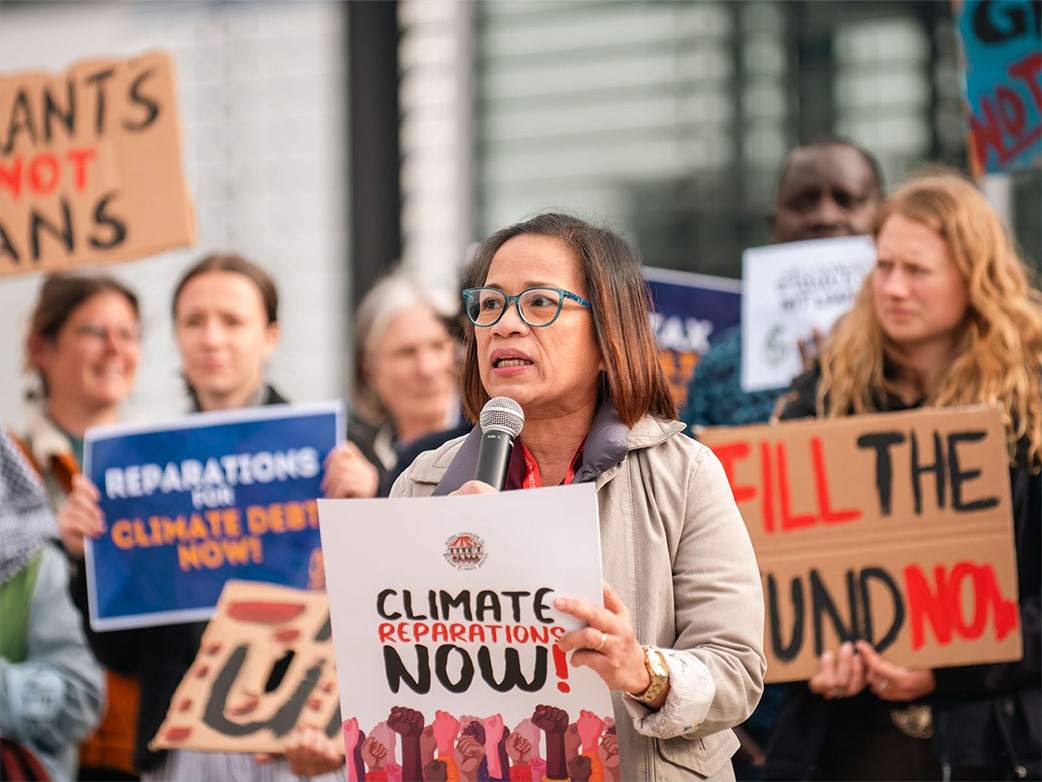
Photo: Tetet Nera-Lauron
For decades, Tetet Nera-Lauron has worked at the intersection of climate justice, international advocacy and social movements. As a consultant with the Rosa Luxemburg Stiftung and a representative of the Women and Gender Constituency on the Santiago Network Advisory Board, she follows the negotiations shaping finance, Loss and Damage and sustainable development—always with one question in mind: what do these decisions mean for the people most affected?
In this conversation, Tetet reflects on activism, the role of civil society in international negotiations, the frustrations and hopes of following the UN climate process for decades, and why she believes meaningful change depends on both movements on the ground and advocacy inside negotiating rooms.
Who is Tetet, beyond your work? Tell us a little about yourself.
I am a mother of four children, including 17-year-old twins, and soon I will also become a grandmother to two.
Outside of work, I have always loved spending weekends at the beach with family and friends. And being Filipino, all it takes is a microphone for us to put on a mini-concert! I never got tired of marathon karaoke sessions that could start at midday and last until dawn.
Life has changed significantly over the past two years. I recently lost my husband after his valiant struggle with a rare type of cancer. I am still trying to navigate this new reality and trying to find the “new” me. I hope that one day I will be able to have fun again and find happiness. For now, just being able to show up and do ordinary things takes a great deal of effort.
What does your work entail?
I am a consultant with the Rosa Luxemburg Stiftung (RLS), the political foundation of Germany’s Left Party.
My work focuses on multilateral processes related to Financing for Development, the Sustainable Development Goals, the Right to Development, and the United Nations Framework Convention on Climate Change (UNFCCC).
RLS is a political education foundation that supports social movements around the world. My role involves following these international processes, unpacking what is happening, and, more importantly, analysing and communicating what the outcomes mean in terms of bringing about meaningful socio-economic transformation for people and the planet.
I like to think my work contributes, even in a small way, to strengthening social movements by providing resources they can use in their political education work. It also contributes to challenging governments in the Global North, particularly the German government, to do the right thing not only for their own citizens but also for the people of the global majority.
What motivated you to do this work?
I have always been an activist.
Growing up middle class but always under the constant threat of slipping into poverty meant that exclusion, inequality, and injustice were not abstract concepts. They were realities that confronted me every day.
Being an activist gave me a structural understanding of the world and of climate change. To me, climate change is ultimately about political economy. The answers therefore go far beyond technical discussions about reducing parts per million or limiting global temperature rise. Climate justice is a holistic, intersectional and multidimensional struggle that enables us to imagine and claim a better world for people and the planet.
For many years, I questioned the effectiveness of international diplomacy and the United Nations in addressing the world’s many crises. I often wondered whether engaging in these spaces simply legitimised an illusion of hope, and whether our efforts would be better spent organising and mobilising communities on the ground.
Civil society has long adopted what is often called an “inside-outside” strategy. The “inside” focuses on advocacy and influencing policy, while the “outside” involves organising, mobilisation, and broader social movement activities.
For a long time, I deliberately avoided working on the “inside” because I thought that space belonged to policy experts and negotiators. Over time, I realised that the struggle for transformative change is not about choosing one over the other. These spaces are deeply connected, and both advocacy and campaigning are necessary. We are all part of a larger movement ecosystem, each holding one of many essential pieces in the mosaic of global change.
There remains an urgent need for advocacy within intergovernmental spaces because communities experiencing the worst impacts of climate injustice are demanding reforms, including finance for adaptation and loss and damage. Civil society has a responsibility to raise these issues on behalf of people who cannot access these negotiations themselves.
Participation in these spaces was never handed to civil society. It was fought for. As that space for policy influence continues to shrink, we cannot afford to leave it empty. Others will quickly fill it.
That is what continues to motivate me to keep fighting the good fight.
What have been the highlights of your work on loss and damage?
I do not really think of what I do as a career. I feel privileged that the work I am passionate about is also my profession.
One highlight has been serving as a representative of the Women and Gender Constituency on the Santiago Network Advisory Board. It gives me a seat at the table and a voice in discussions and decision-making, while allowing me to bring forward the perspectives of the many people experiencing the impacts of a crisis they did so little to cause.
It is a long way from my first COP, where I can honestly say I was more of a tourist.
I have now attended many COPs, yet I still cannot say I fully understand the complexities of international climate diplomacy. Nor can I reconcile the powerful speeches from world leaders about the climate emergency with the reality that, after more than a quarter of a century of negotiations, climate change has become an even greater problem.
At the same time, my heart still skips a beat whenever I watch developing country negotiators fight to push wealthy countries to acknowledge their historical responsibility for the climate crisis and to provide support for the massive losses and damages experienced by countries in the Global South.
My heart has also been broken many times by negotiation outcomes that fail to match the urgency and scale of the climate crisis. Every session that ends without sufficiently ambitious and just outcomes leaves millions of lives and livelihoods at even greater risk. I am also deeply frustrated that corporations are increasingly presented as central to climate solutions when it is their long history of extraction and profiteering that has contributed so significantly to this crisis.
What helps you keep going?
What gives me hope is seeing people organise.
Across the world, communities are standing up to polluters and extractive industries. They are reclaiming control over decisions that affect their health, their bodies and their futures. They are protecting democracy, resisting corporate capture and authoritarianism, and building movements rooted in care, justice, and liberation.
From local organising to international movements, people are refusing to accept a world governed by corporate greed and authoritarian politics.
And on a personal level, I take great pride in knowing that my 17-year-old twins are proud of what their mama does, even if it means I am away from home for long periods of time.

Read the full text here:

Read the full text here:

Watch the video here: