
Stories
TALKING BIODIVERSITY, LOSS AND DAMAGE, AND LAW AT THE UN BIODIVERSITY CONFERENCE IN YEREVAN, ARMENIA
27/10/26
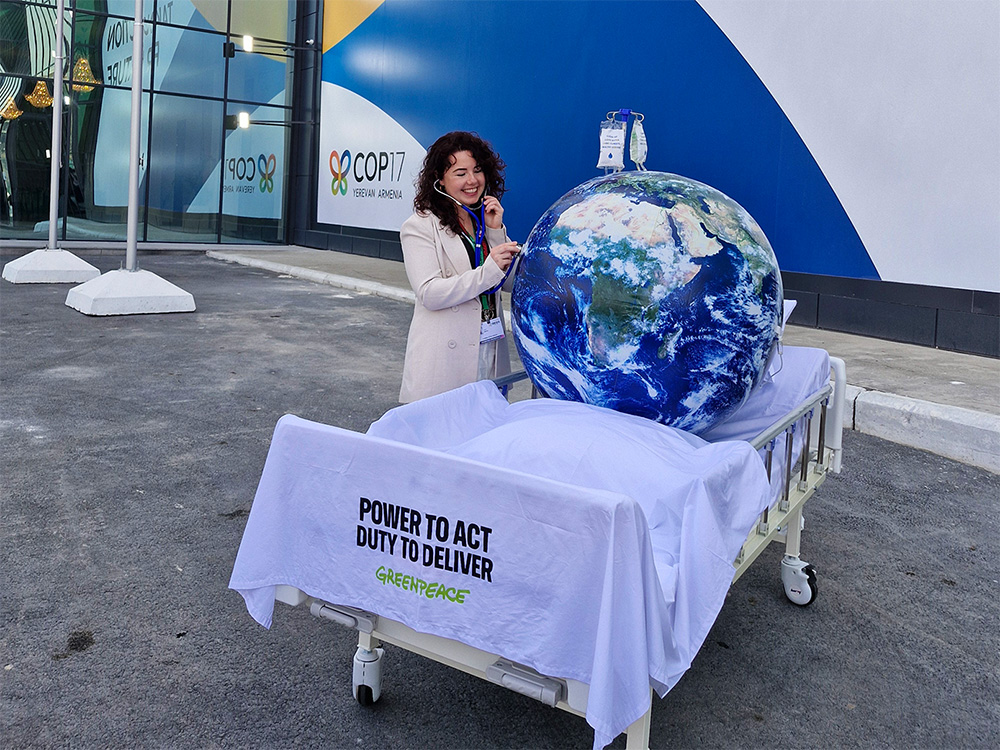
Photo: Heidi White
I have been in Yerevan, Armenia, for a week so far. I am here attending the UN Biodiversity Conference, or, in technical jargon: the 17th meeting of the Conference of the Parties to the UN Convention on Biological Diversity.
This is my first time attending a Biodiversity Convention meeting. So, what is the purpose of my being here?
First it is helpful to rewind a little bit. Over thirty years ago, to be precise.
At the 1992 Earth Summit, held in Rio de Janeiro, Brazil, global leaders recognised that humanity stood at a defining moment in history but were optimistic that international cooperation could resolve the serious challenges facing the planet.
The UN Climate Change Convention and the Convention on Biological Diversity were opened for signature, and a process was agreed upon that shortly thereafter led to the UN Convention to Combat Desertification. Later called the ‘Rio Conventions’, these three international agreements, together with the Rio Declaration, would strengthen the ability of the multilateral system to address the interconnected challenges of climate change, biodiversity loss, and desertification.
Fast forward to May 2018, when I started following the UN Climate Change process. My entry point was to follow the Suva expert dialogue, which informed the preparation of a technical paper on finance for addressing loss and damage caused by the adverse effects of climate change.
I learned that the ‘adverse effects of climate change’ means the changes resulting from climate change that cause major harm to ecosystems, socio-economic systems, and human health and welfare. Although the ultimate objective of the Climate Change Convention was to prevent this harm, with developed country Parties responsible for taking the lead–this major harm was already happening and the global community needed to respond.
What followed was more than eight years of work aimed at advancing ambitious progress on this topic. In this time, the institutional architecture on Loss and Damage has evolved from the Warsaw International Mechanism for Loss and Damage (WIM) Executive Committee to also include the Santiago Network, and the Fund for Responding to Loss and Damage.
However, as we approach COP 31 in Antalya, Türkiye, the response of the global community to Loss and Damage is not yet adequate in terms of its accessibility, scale, and speed of delivery. These issues are falling through the cracks as attention is divided among a wide range of critical issues.
It is in this context that I have found myself wondering what more can be done? We now have the institutions and they are working to deliver for developing countries. But how can we rapidly scale up this response, ensuring that there is justice for those on the frontlines who are least responsible for this climate crisis?
So why the Convention on Biological Diversity?
Earlier this year, there was a UN General Assembly resolution welcoming the 2025 Advisory Opinion of the International Court of Justice on the obligations of States in respect of climate change (ICJ AO), and recalling the 2024 Advisory Opinion of the International Tribunal for the Law of the Sea on climate change and international law. This resolution was the next step in a trend across international courts and tribunals, clarifying States’ legal obligations in respect of climate change.
The ICJ AO generated renewed energy for the power of international law in the fight for climate justice. It therefore seemed timely to take this inspiration and look further afield to better understand and strategise on how to enforce liability, accountability, and ensure adequate redress for climate harm.
The Climate Change Convention and its Paris Agreement are the primary international intergovernmental forums for negotiating the global response to climate change. However, the relevant applicable law on States’ obligations in respect of climate change is now far-reaching, and this includes obligations under the Convention on Biological Diversity.
So what have I learned so far? My mind is overflowing with new information, but as we enter the second week of negotiations, I have distilled four lessons:
- Climate change is one of many drivers of loss of and potential damage to biodiversity globally. Alarm at the continued loss of biodiversity and the threat this poses to nature and human wellbeing led to the adoption of the Kunming-Montreal Global Biodiversity Framework (GBF), which is under its first review at COP 17. Under the GBF, there is a dedicated agenda item to negotiate agreements to address the interdependent and interconnected crises of biodiversity and climate change.
- Conversations on resource mobilisation are not so different across the Conventions. Both are facing challenges of international public finance being insufficient, unpredictable, and not accessible enough. Meanwhile, wealthy countries most responsible for the harm caused to nature are more focused on advancing the work to ‘broaden the contributor base’ to generate adequate financial resources instead of identifying how they can contribute their fair share.
- In climate negotiations, the words "liability" and "compensation" are practically taboo. For biodiversity, they are literally written into the Convention. Under Article 14(2) of the Convention on Biological Diversity, governments agreed decades ago to examine "liability and redress, including restoration and compensation, for damage to biological diversity." We already see this in practice through the Nagoya–Kuala Lumpur Supplementary Protocol, which sets rules for damage caused by living modified organisms. While its current scope is narrow and uptake by Parties is also a major hurdle, the contrast is nonetheless striking. While the Climate Change process treats Loss and Damage strictly through a lens of voluntary solidarity—keeping legal liability off the table—biodiversity governance leaves the door open to real legal accountability.
- We need to talk about the elephants in the room (and why ignoring them perpetuates biodiversity destruction). This new report, launched here at COP 17, contains many lessons for the climate change agenda: one being the need to shift away from a legal system that privileges corporate rights over environmental regulation. At an event on the report, I learned of the case of Tethyan Copper v Pakistan, where Investor-State Dispute Settlement (ISDS) proceedings saw Pakistan ordered to pay USD 5.8 billion to an Australian mining company for the denial of a mining licence. This is more than the grants and loans received by Pakistan in the aftermath of the catastrophic floods it suffered in 2022, which contributed significantly to the case for establishing the Fund for Responding to Loss and Damage.

Read the full text here:

Read the full text here:

Watch the video here:
Resources
Our 2025 negotiators brief which unpacked the ICJ AO in the context of Loss and Damage: https://www.lossanddamagecollaboration.org/resources/the-obligations-of-states-in-respect-of-climate-change
The latest non-paper being discussed under the Biodiversity and climate change agenda: https://www.cbd.int/doc/c/a461/a331/e5c6c5398136d3213681fce8/cop-17-wg2-non-paper-item-18a-v3-en.pdf
The latest non-paper being discussed under the resource mobilisation agenda: https://www.cbd.int/doc/c/7fb5/cc3f/b224048b5874803dbb166509/cop-17-wg1-non-paper-item-08a-v3-en.pdf
The draft decision for adoption on the Nagoya-Kuala Lumpur Supplementary Protocol on Liability and Redress: https://www.cbd.int/doc/c/cda7/558b/bb60ffc71a7483d051c84810/cp-mop-12-l-03-en.pdf
The global strategy for fungal conservation, launched at COP 17: https://www.globalfungalconservation.org/