Publications
Driving the System Change Needed to End Loss and Damage From Climate Change
17/9/26
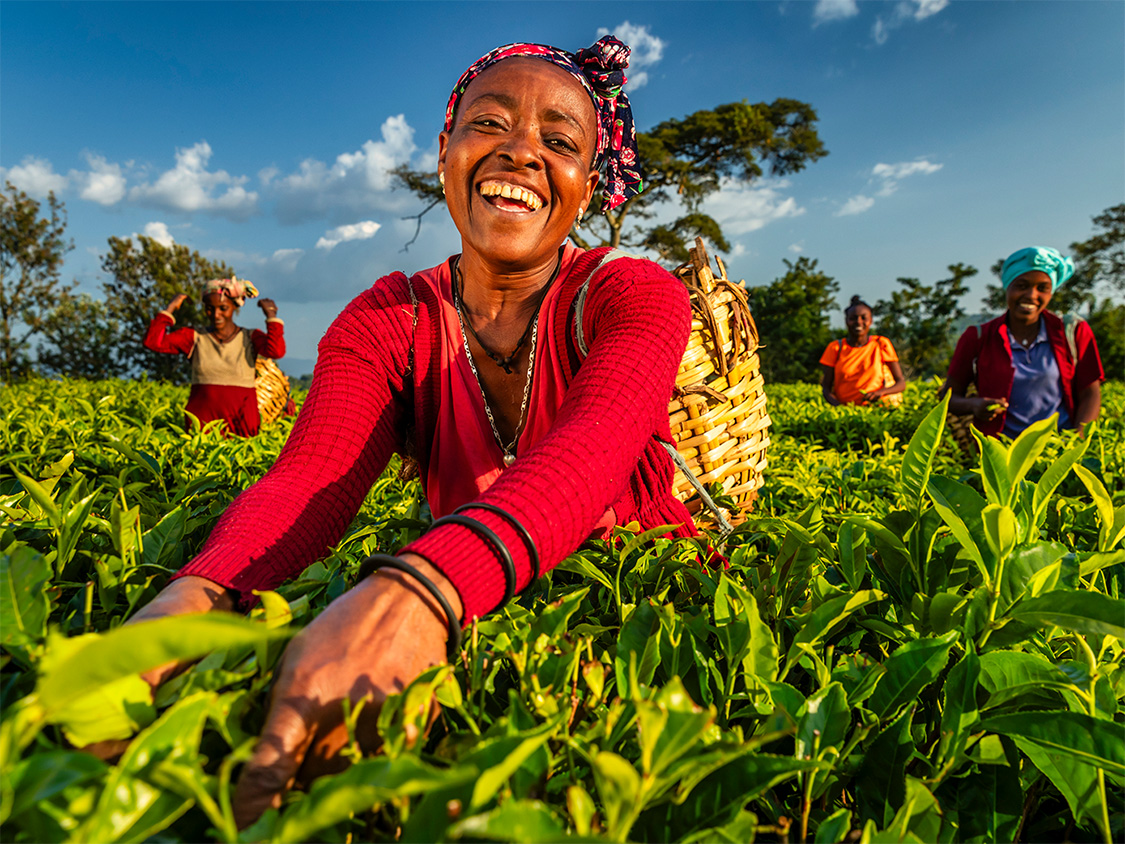
Women harvesting tea leaves on a plantation in central Ethiopia © hadynyah / iStock
In a previous brief, we laid out our five-year vision for responding to loss and damage caused by climate change under the United Nations Framework Convention on Climate Change (UNFCCC). In a subsequent paper we presented a “mosaic of solutions” that can meet the Loss and Damage needs of the Global South while building long term resilience and advancing sustainable development. In the latter, we concluded that systems change will be needed for all humans, ecosystems, and species to thrive, not just survive, in the midst of climate change and other planetary challenges.
In this paper, we consider what systems change entails and what opportunities there are to advance it. To do so, we take the Doughnut of Social and Planetary Boundaries as an analytical framework to guide our inquiry into how to end ecological overshoot of the planetary boundaries while addressing social shortfalls, such as a lack of access to healthcare, food, and education. However, we do so recognising the importance of raising questions about who gets to set planetary boundaries, whose interests they serve, and how the task of ending ecological overshoot and addressing social shortfalls will be shared equitably.
Key elements of this paper include:
- An introduction to why systems change is required, the origins of the problem, what systems change entails, and the relationship between loss and damage from climate change and systems change.
- A concise overview of the transformations needed to end ecological overshoot and address social shortfalls across the nine planetary boundaries and 12 essential dimensions set out in the social foundation of the Doughnut of Social and Planetary Boundaries. (a more detailed unpacking is provided in two annexes).
- Consideration of the need to: 1). End dependence on economic growth; 2). Work less and value care more; 3). End the hegemony of Global North Science, knowledge and expertise; 4). Restore our reciprocal relationship with more-than-humans; 5). Expand rights to more-than-humans and criminalise ecocide; 6). Rethink reparations; and 7). think seven generations into the future.
- How the following can be leveraged strategically to advance change: 1). Positive tipping points; 2). Mobilisation of 3.5 percent of the population; 3). Achieving a collective vision for the future; 4). Litigation and internal law; and 5). Embracing plurilateralism and coalitions of the willing.
This paper is accompanied by an executive summary which can be accessed here.

Read the full text here:

Read the full text here:

Watch the video here:
The development of this paper has been supported by Rosa-Luxemburg-Stiftung New York Office with support from the German Ministry for Economic Cooperation and Development (BMZ).