
Publications
MEASURING DISASTER RESILIENCE IN MENA COUNTRIES AND ITS IMPACT ON DISASTER LOSSES
8/12/25
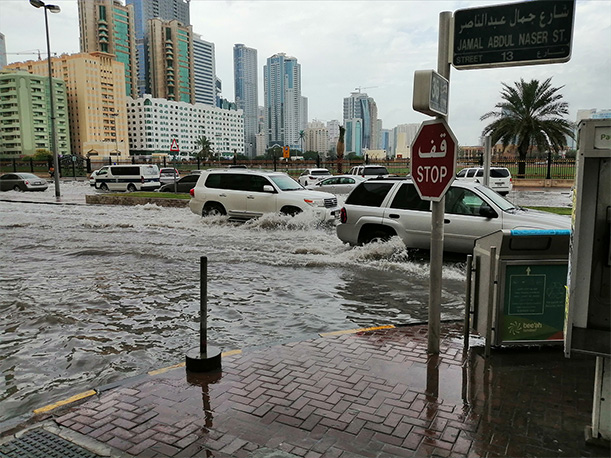
Sharjah, United Arab Emirates – 14 January 2020: A flooded street after unusually heavy rains for 2 days across the UAE, the highest rainfall (184.4mm) in the arid desert country since 1996. Photo credit: Arnold O. A. Pinto / Shutterstock
Disaster resilience is a protective feature aimed at reducing the effects of natural disaster events and losses resulting from these events. This study develops a Disaster Resilience Index (DRI) for Middle East and North Africa (MENA) countries to assess resilience across ten dimensions, including economic, social, institutional, infrastructural, and environmental factors. Unlike most prior studies, which focus on individual countries or use narrower sets of indicators, this study provides a multi-country, region-specific framework tailored to MENA’s socio-economic and environmental heterogeneity. The index integrates geospatial data on disaster risk from geographic information systems (GIS) and a natural hazard risk dimension. Validation using disaster-related fatalities, supported by a dual Principal Component Analysis (PCA) based sensitivity analysis, confirms the robustness of the DRI and reveals that countries with stronger governance, higher human capital, and robust infrastructure tend to exhibit greater resilience, while fragile states and resource-dependent economies are more vulnerable. Notably, the DRI calculated using both dimension-specific and all-indicator PCA produces closely aligned values, indicating the choice of conducting PCA at the dimension level does not significantly alter the overall assessment of disaster resilience. These insights provide a foundation for targeted disaster risk reduction strategies and highlight areas where international cooperation and policy interventions can strengthen resilience in the region.

Read the full text here:

Read the full text here:

Watch the video here: